


Club Story: Baseball Manager
4.01.00 Reviews
App Specs
- Version
- 2.1.8
- Updated On
- License
- Free
- Downloads
- 10,000+
- Developer
- NBstudio
- Categories
- Sports
- Platform
- Android
Screenshots

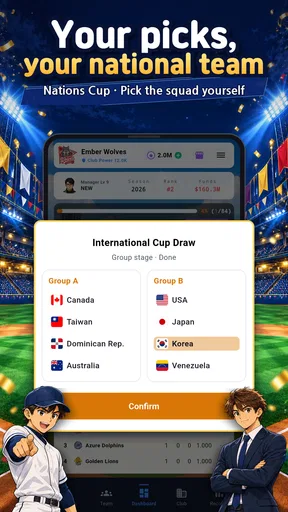
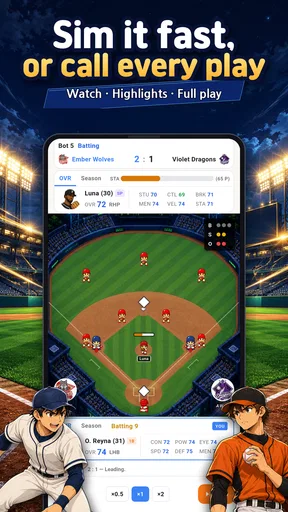
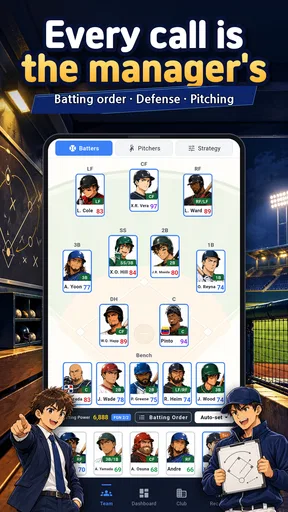

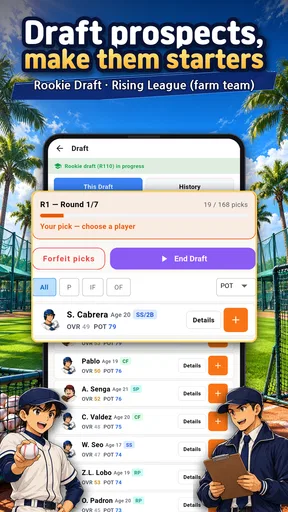
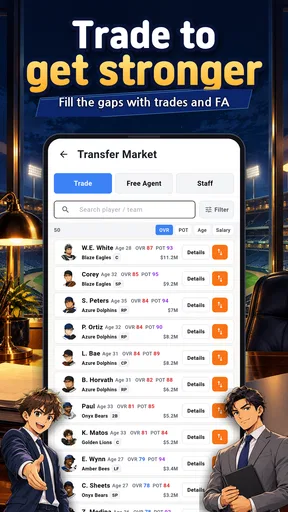

 Analysis by AppCompare
Club Story: Baseball Manager is the kind of sports game I open when I want to think about baseball without having to play every pitch myself. Instead of controlling a single athlete, I take responsibility for a club: choosing players, shaping a roster, making development decisions, and trying to turn a collection of prospects and veterans into a convincing professional team. That broader viewpoint gives the game a different rhythm from arcade baseball, and it is the main reason I found it appealing.
Developed by NBstudio, this free baseball management game sits in a comfortable space between a quick sports pastime and a more deliberate team-building experience. It is rated for Everyone, runs on Android 7.0 or later, and the current version is 2.1.7. The game has reached over ten thousand installs and holds a 4.0 average from around four hundred ratings, which suggests a modest but real player base rather than a huge, crowded community.
My first impression was that the central idea is easy to understand: build a club, make decisions, and watch the results develop over time. The harder part is deciding which choices matter most in the moment. That is where the game becomes more interesting than its short store description suggests. It asks me to think about the whole organization, not just chase a single exciting match.
Building a club feels more personal than simply winning matches
The strongest part of Club Story: Baseball Manager is its long-view structure. A match result matters, but it is not the only thing I am judging. I also care whether a player fits the direction of the team, whether a promising youngster deserves patience, and whether a short-term improvement could create a problem later. That makes each decision feel connected to the next one.
I particularly like this approach for short sessions spread across a day. I can check the state of the club, make a few deliberate choices, and leave without feeling that I have abandoned an action-heavy game halfway through a match. It works well during a commute, a lunch break, or a quiet evening when I want something more thoughtful than a reflex game but less demanding than a full simulation.
The game’s appeal depends heavily on whether you enjoy responsibility without constant direct control. If your favorite part of baseball games is batting yourself, throwing pitches, or making defensive plays with immediate input, this will feel indirect. Here, the satisfaction comes from seeing a plan take shape. I am not trying to hit a home run with my own hands; I am trying to create a team that has more chances to produce good results.
That distinction also helps explain who should skip it. Players looking for a fast arcade experience, licensed stars, or a presentation built around dramatic on-field action may find the management perspective too restrained. I would recommend it more readily to someone who enjoys roster puzzles, gradual improvement, and the feeling that a bad decision can teach something useful.
Worth Reading Before You Choose

Baby Panda World Brings Quick Play to Modern Phones, but Its Game Library Feels Busy

ESPN’s Live Game View Makes Following Close Games Easier

QuizzLand Review: A Good Fit for Short Trivia Breaks, Not Every Player

Basketball Stars: Multiplayer Is Fast, but Can It Recover When Matches Go Wrong?

WEBTOON Turns Phone Updates Into a Better Reading Routine

Link to Windows Runs on Shared Habits, Not Social Feeds
How I approach the early club decisions
My practical advice is not to treat every player as equally important. Early on, I look for a clear identity for the team rather than trying to improve every area at once. A club that is merely average everywhere can be harder to understand than one with an obvious strength and a visible weakness. The weakness gives me a development target, while the strength gives the team a reliable foundation.
A useful routine is to separate decisions into three groups: choices that affect the next result, choices that improve the medium-term roster, and choices that are mainly experimental. I avoid spending all my attention on the first group. Winning the next game is satisfying, but a manager game becomes much more rewarding when I can explain why the team improved over several decisions instead of reacting to every result.
Another small but important habit is to review a player’s role before making a change. A promising player may look disappointing if I expect immediate production from someone who needs time to develop. Conversely, keeping a familiar player simply because the name feels safe can block a better long-term plan. The game encourages me to think in terms of fit and timing, not just raw excitement.
That is one of the less obvious strengths here: the game can turn uncertainty into a planning exercise. I do not always know whether a move will pay off immediately, so I have to decide how much risk the club can absorb. A strong team can test a developmental choice. A struggling team may need a safer option first.
Progress is satisfying, but it can also create pressure
Progression in a manager game is rarely just a reward. It also creates pressure to protect what has already been built. Once I become attached to a developing roster, a poor run feels more meaningful than a random loss in an arcade title. I start asking whether the problem is temporary, whether I chose the wrong direction, or whether I am holding onto a player for sentimental reasons.
This is where I found the game most engaging. A club does not feel like a simple collection of upgrade buttons. The decisions have a narrative quality: a player gets an opportunity, a plan fails, or a promising group begins to look like a real team. Even when the systems are presented simply, that context gives ordinary choices more weight.
The trade-off is that progress can feel slower than in games designed around constant rewards. If you need a new unlock or a dramatic power increase every few minutes, the management pace may test your patience. I prefer it when I am in the mood to make careful choices, but I would not launch it expecting the instant feedback of a casual arcade baseball game.
For everyday play, I recommend setting a small objective before opening the game. I might focus on stabilizing one part of the roster, giving a developing player a fair chance, or checking whether the current club strategy still makes sense. That keeps a short session focused and prevents me from making random changes just because I have a few spare minutes.
A second useful approach is to keep a mental record of why I made a major change. If the result is poor, I can judge the decision more fairly. A good decision can produce a bad short-term result, and a weak decision can occasionally get lucky. Separating process from outcome is especially valuable in a baseball manager because the sport naturally includes swings of fortune.
Spending, fairness, and what I would want to know before committing
Club Story: Baseball Manager is free to download, but it includes in-app purchases ranging from $0.99 to $35.99 per item. That is the most important spending context for a new player. The purchase range tells me that optional transactions are part of the game’s business model, but it does not by itself prove that spending is required, that purchases are cosmetic, or that paying guarantees success. I would not make any stronger claim than that.
Because of that uncertainty, I approach the game with a simple rule: play first, spend later, and only consider a purchase if I understand exactly what it changes. I would not buy something merely because the club is having a bad week. A temporary losing streak is part of the management experience, while an unclear purchase can affect how satisfying the progress feels afterward.
The free entry point is valuable because it lets different kinds of players test the core loop without an upfront commitment. Someone who enjoys team planning may find enough interest in the basic experience to keep playing without paying. Someone who dislikes indirect sports games will discover that quickly and can leave without having bought a premium title.
At the same time, the possible cost of individual items means budget-conscious players should be careful around impulse decisions. I would use device-level purchase protections, especially if children might access the game, even though the content rating is Everyone. The age rating describes suitability of content; it should not be confused with a promise that every purchase decision will be simple or pressure-free.
Can a non-paying player enjoy the club-building loop?
Yes, the free starting point makes it reasonable to try the game without spending, but I would define “enjoy” in the right way. A player who likes gradual team construction can get value from making decisions and watching the club develop. A player who wants the fastest possible route to a dominant roster may feel more tempted by purchases, depending on how the progression is presented during play.
I did not find it useful to judge fairness only by asking whether purchases exist. The better question is whether I still feel that my decisions matter when I do not pay. If roster choices, patience, and planning remain meaningful, the game can work as a management experience. If every difficult moment seems designed to push me toward a transaction, the relationship changes from strategy to spending management, which is much less appealing.
That is also why I would avoid promising a completely even competitive environment. The available purchase range makes it sensible to pay attention to how other players progress, but I would not invent a claim about rankings, matchmaking, or player-versus-player balance. Those details matter greatly to fairness, and they should be judged from the actual in-game experience rather than assumed from the presence of purchases.
Where it compares well with other baseball choices
Compared with a traditional arcade baseball game, Club Story: Baseball Manager gives me more ownership over the organization and less direct control over each moment. That makes it better for planning, but worse for players who want immediate physical interaction. Compared with a large, highly detailed sports simulation, it is easier to approach because the central idea is clear and the sessions can be shorter, though dedicated simulation fans may want deeper control than this compact mobile format provides.
It also differs from a simple idle game. I am not interested only in collecting rewards while the club runs in the background. The appeal comes from interpreting the team’s situation and choosing what to do next. If I remove that decision-making and treat the game as a reward machine, I lose much of what makes the baseball setting worthwhile.
For a friend deciding between this and an arcade alternative, I would ask one question: do you want to be the player, or do you want to be the person responsible for the club? If the answer is the latter, this is the more natural choice. If the answer is the former, a game with direct batting and pitching controls will probably provide more immediate fun.
Small habits that make the experience better
My first tip is to resist changing too many things after one disappointing result. Baseball can make a good plan look bad for a short stretch, and constant reactions make it difficult to learn what actually helped. I prefer to make one meaningful adjustment, observe the next part of the club’s progress, and then decide whether another change is justified.
My second tip is to treat developing players as projects rather than emergency solutions. Giving someone a chance can be rewarding, but it should fit the club’s current ability to absorb mistakes. If the team is already unstable, I would avoid rebuilding every area at once. If the club has a dependable base, that is the better moment to test a longer-term idea.
My third tip concerns purchases: write down what you expect before confirming one. If the goal is to solve a specific bottleneck, ask whether the item actually addresses that bottleneck or merely makes progress feel faster. This simple pause protects the strategic side of the game. Spending should support a decision I already understand, not replace the decision.
A fourth tip is to judge the game over several sessions rather than one opening burst. The appeal is tied to the relationship between choices and consequences. A quick first look may show the theme and basic structure, but it will not tell me whether I enjoy managing uncertainty, recovering from mistakes, or committing to a development plan.
The questions I would ask before installing
Is it suitable for a younger player? The game carries an Everyone content rating, so its listed age suitability is broad. I would still explain the purchase option to a child and keep spending controls in place, because content suitability and financial safeguards are separate concerns.
Will it run on an older Android phone? The minimum requirement is Android 7.0, which makes the compatibility threshold relatively accessible for devices that support that operating system. Performance can still depend on the individual phone, but a player using an older Android version should check that requirement before trying to install it.
Is it worth paying for? My answer is conditional. It is worth trying for free if you enjoy baseball strategy and want to build a club rather than control every play. I would only pay after identifying a purchase that has a clear purpose and after deciding that the game’s management loop is already enjoyable without it.
Is it a good replacement for a full console-style baseball simulation? No, not for someone seeking deep presentation and direct match control. It is better understood as a mobile club-management game. Its strength is the compact decision loop, not the promise of reproducing every part of a premium sports simulation.
Does the rating guarantee competitive fairness? No. The 4.0 average from around four hundred ratings gives a useful snapshot of general player reaction, but it does not explain how spending affects progression or competition. I would evaluate that personally by watching whether my non-paying decisions continue to feel meaningful.
My trust verdict on the experience
After spending time with Club Story: Baseball Manager, I see a focused sports game with a clear audience. It is most convincing when I slow down, accept that not every result will validate my plan, and enjoy the process of shaping a club. The free entry point lowers the risk of trying it, while the in-app purchase range means I should remain deliberate about spending.
My main reservation is not that purchases exist; it is that fairness depends on details that cannot be responsibly assumed from purchase availability alone. I would want every player to judge how much influence money has on progression and competition through actual play. Until that is clear from personal experience, I would keep expectations measured and avoid treating paid options as necessary.
For me, the best use case is a short, thoughtful session in which I check the club, make one or two reasoned moves, and return later to see whether the plan worked. The game is less suitable for someone who needs constant action or wants a fully hands-on baseball match. But if you like the idea of turning a modest roster into a coherent team, Club Story: Baseball Manager offers a pleasant management-focused alternative.
My final recommendation is to install it as a free experiment, not as a promise of an all-encompassing baseball simulation. Give the club enough time for its decisions to matter, keep purchases intentional, and decide whether the progress feels earned. For the right player, the reward is not simply winning; it is recognizing that the team improved because of a choice I made.
Pros
- Simple controls make managing games easy for beginners.
- Season progression gives the game a satisfying long-term goal.
- Team customization adds personality beyond basic match management.
- Short play sessions suit quick breaks and mobile gaming.
- Light strategy elements keep matches engaging without being overwhelming.
Cons
- Progress can feel repetitive after managing several similar seasons.
- Some features may be locked behind in-app purchases or extra progress.
- Limited real-time interaction may disappoint fans of action baseball games.
- Balancing player development and finances can be unclear at first.
- Performance and loading times may vary across older mobile devices.
FAQs for Club Story: Baseball Manager
What is Club Story: Baseball Manager?
Club Story: Baseball Manager is a baseball management and strategy game in which you build, organize, and develop your own team. Instead of controlling every pitch directly, you generally focus on decisions such as signing players, improving facilities, setting lineups, managing finances, and preparing the club for competition. It is designed for players who enjoy long-term progression and managerial planning more than traditional arcade-style baseball gameplay.
Is Club Story: Baseball Manager free to download and play?
The game can typically be downloaded without an upfront purchase, but players should check the current store listing for the exact pricing and availability in their region. Like many mobile management games, it may include optional in-app purchases for resources, progression, or convenience. You can usually begin playing for free, although advancing faster or competing more aggressively may encourage spending. Review the purchase settings before handing the game to children.
Do I need an internet connection to play Club Story: Baseball Manager?
An internet connection may be required for important parts of Club Story: Baseball Manager, including account synchronization, online competitions, event updates, advertisements, and server communication. Some menus or basic activities might work temporarily while offline, but you should not assume that the complete game is available without a connection. If you plan to play while traveling, verify the latest requirements on the Google Play or App Store page before downloading.
What can I manage in Club Story: Baseball Manager?
The main appeal is the range of club-management decisions available to you. Depending on the current version, you may be able to recruit and develop players, choose lineups, adjust tactics, upgrade training or club facilities, manage budgets, and compete across different leagues or events. Success depends on balancing immediate results with long-term development, so the game is better suited to players who enjoy planning, statistics, and gradual team improvement.
Is Club Story: Baseball Manager suitable for casual players and baseball beginners?
Baseball beginners can enjoy Club Story: Baseball Manager, especially if they are interested in building a team and learning through progression rather than understanding every rule immediately. However, the game may feel more complex than a simple pick-up-and-play sports title because it includes menus, upgrades, player development, and strategic choices. Casual players should expect regular management tasks, while fans of simulation games will likely appreciate the deeper systems and long-term goals.


